Friday, April 24, 2015

Weekend Review - Anna Larson - The Horse That Haunts Dreams


This weekend's review features freelance writer, Anna Larson, and her memoir, The Horse That Haunts Dreams, a touching story of the life of her beloved horse, Hobo.

The Horse That Haunts Dreams by [Larson, Anna]

Here's my Review:


A story every horse enthusiast can relate to and love.


The horse that haunts dreams is a touching memoir about a young woman and the horse that she will never forget. Full of wonderful stories and memories of her beloved Hobo, Anna tells a wonderful tale that spans Hobo's life. Most horse enthusiasts have experienced the same one-of-a-kind bond that Anna describes, and reading her collection of memories brings our own journeys back to life in our hearts. Anna makes her journey with Hobo a compelling, humorous, and heart-touching read.
I would've liked to see it written more as a narrative than a memoir, as it jumped about a few times. Some of the stories could've been expanded and elaborated to make it sound less journalistic. But as it's written, it is still a solid 4 star read, partially due to it reminding me of my own unforgettable horse, a APHA gelding named Leroy. :)


Where to find Anna Larson:


Blog 


Where you can find The Horse That Haunts Dreams:


More Thoughts:

To elaborate: The memoir bounces back and forth from a narrative storyteller, to a more factual, journalistic approach. Both styles are fine, but personally, (as a fiction reader and writer) I prefer the more narrative style. By sticking with the storytelling instead of the reporting narration, Anna could have expanded on her and Hobo's stories quite a bit. The book itself could have doubled in size, if not more. 
Still, I want to make it clear that I enjoyed reading it and since I am a horse-lover myself, I could really connect with Anna and her wonderful horse, Hobo.


Getting to know Anna Larson:
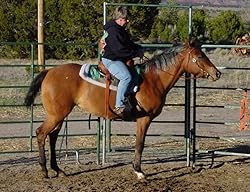
Anna Larson

Anna Larson is a freelance writer and long time horse owner. She attended New Mexico Military Institute in Roswell, New Mexico and Louisiana Tech University in Ruston, Louisiana. She obtained her Bachelors of Science degree in Equine Science before enlisting in the U.S. Army as a veterinary technician. After leaving the Army she returned to New Mexico where she still lives with her partner and her horses.


A little more from Anna:

What inspired you to write your first book?


In 2007, a horse I'd owned since he was a baby, died at the age of 23. Shortly after that he started haunting my dreams. Every night I'd have this dream about another horse that was "in the dream", a reincarnation of my dead horse. Three months later, I found a baby horse that almost matched the descriptions in my dreams. I bought that foal and the next day the dreams stopped.  It was the freakiest thing that's ever happened in my dreams or real life. The foal I bought was so much like my old horse, right down to being allergic to vaccinations, that it's scary.  As for writing, that dream did start me on the writing path. I had no plans to be a writer before that, but I had to write that story down.

What books have most influenced your life? 


Every book I've ever read has something to teach me. The truly badly written ones show me what not to do and the well written ones give me a guide for my own work. However the most influential book in my life I would have to say would be "Mustang, Wild Spirit of the West" by Marguerite Henry. Without that book I wouldn't have had my own Hobo.

If you had to pick only one, who would be your favorite author?


That's really tough to choose between my childhood favorite Marguerite Henry or my adult favorite Dick Francis. 

If you could cast your main character(s) in a Hollywood adaption of your book, who would land the rolls?


That's a really hard one since it's difficult to cast a horse and a mule. As for me, I think Emma Watson in her short hair would most closely resemble a younger me. 

As a child, what did you want to be when you grew up?


At first I wanted to be a truck driver, but my dad took me to the truck stop and one of his buddies let me look into the cab of the truck. I remember thinking I was way too tiny to ever grow big enough to drive a truck so I changed my mind and decided on being a jockey instead. 

What do you like to do when you aren't writing? 

I ride my horses, keep up the farm, garden, and crochet. I'm also an avid reader and spend a part of every day with "my nose in a book" as my mom likes to say. 

What is one tip you'd give to up & coming authors?


Make sure to get an editor. No matter what, you will need an editor. Even with an editor, mistakes will happen. You can minimize your mistakes and your negative reviews by making sure your work is as mistake free as possible. I run my manuscript through beta readers, an editor and then I convert it to a kindle format and have my kindle text to speech read the text back. It's amazing what mistakes, awkward sentences and so forth you will find by listening to the story read back. Having the text to speech option keeps your eyes from playing tricks with your mind. You hear the mistakes instead of the eyes skipping over them. 

If you could spend the day with one person, alive or dead, who would it be and why?


I'm a huge fan of horse racing and I used to work at several race tracks, but I wasn't old enough to have been around the famous Bill Shoemaker when he was in his riding prime. I watched as many races as were televised way back when was a kid. I always idolized the man and his riding skills. 

What's next for you?


I'm debating between Equine Fantasy of some type or a western revolving around a horse, but nothing solid yet. 


A big thanks to Anna Larson for being such an 'open book', no pun intended! Your tip on the Kindle text speech is brilliant! :)

Friday, March 27, 2015

Avoiding the Cliche Cover - Thursdays with the Author

We've all seen the 'typical' cover for the genres we like to read.

In Historical Romance you see the dashing aristocrat with tight breeches being clung to by the beautiful woman with her dress halfway off her body. Or the muscled Scotsman, kilt, and not much else, ripping the woman's dress off with a look of masculine passion. 

In contemporary romance, long legs with high heels, even though she's wearing nothing else. Or the sexy man in a suit, his rippled abs bared beneath his jacket. Because what savvy business man wears a shirt beneath his suit jacket?

In mystery and suspense we have a blade or weapon in the forefront and perhaps a shadowy figure looming in the background. Shattered glass with a perfect bullet hole, or crime scene tape and police car lights. 

In Women's fiction, recently, you get a house, maybe in the woods or on the beach, with a front porch or smoke curling from the chimney. You might get lucky and have an animal somewhere on the cover, or something on a table that might have something to do with the book.

In YA just a close-up shot of a girl's face, maybe even the whole body, usually doing nothing that has to do with the book. 

In Dystopian you get a symbol or some type of unknown imagery that won't make sense until the book has actually been read. 

In Westerns, particularly the Romance kind, you'll have a hot cowboy, not a speck of dirt on him, maybe throwing hay without his shirt on, because there's no way hay is itchy in anyone's skin, and definitely no way that a cowboy's work will actually make him dirty.  Just a regular ole' Western? Expect a regular ole' cowboy on a regular ole' horse.

In paranormal you can get a sexy vampire that looks completely human, not counting the fangs dripping in blood. Or a shape-shifting hottie, with a well-defined 6-pack, a bunch of tattoos, and walking around in leather pants without a shirt, because a half-naked, tattooed, muscle man is a sure sign of a shape-shifter. 

The only genres that seem have the most original covers are fantasy, sci-fi, and children's, mostly because each world is completely made up, so no one else is going to have the same cover.

Of course, not every novel has the same cliche, stereotypical, cookie-cutter cover, and kudos to those authors that bucked the trend. Still don't believe me? Go to Barnes and Noble, or any book section, in any store, and check out the different genres. Look at the romance section: Can you count on two hands how many covers have at least one person missing clothing? Or making out? Or both? You'll probably need more than ten fingers to count. Check the western section: Lone horse and rider? Cowboy half clothed? Scene with said cowboy doing something that no actual cowboy would do? How about YA: Strangle symbol? Single girl's face or body doing something like standing, or sitting?

Go check it out. The amount of covers that all look the same are astounding.

Am I saying you shouldn't put any of those 'traditional' images on your cover? Yes and No. It really depends on your novel and what you think fits. But what you don't want to do is have your cover looking like everyone else's. Remember my tip from the Creating A Cover For Your Book - What You SHOULD Do, I recommended going to the store and taking a picture of the books in your preferred genre. Take it home and compare your book to those in the picture. Do you stand out? Are you unique and eye-catching? Do you stand out too much? 

Don't automatically go for the cliche and stereotypical. You risk getting lost between the dozens of other books with the same cover.

You know how people say, 'You can't judge a book by it's cover,'? You shouldn't, but the sad fact is that people DO judge a book by it's cover. Half the time, when they're doing an online search, the cover is the ONLY thing that comes up. They have to click on it to read your blurb. People at book stores don't pick up every single book to read the back when deciding. They look at the covers, for the author's name, title, and imagery, to help them decide if they'll like the book. IF the cover catches their eye, they'll click on it, or turn it over, and read the blurb. The blurb, or back of the cover, needs to be just as good as your cover. Because the cover AND the blurb are what gets people to click buy or put it in their shopping cart/bag.

I've written on the cover of subjects MULTIPLE times on this blog and mentioned it in MULTIPLE posts because I believe it is very important. And it's one of the things authors neglect the most.

You can find my cover posts at the links here:


Comparing To Other Writers... Why You Should Be Doing Just That - Thursdays with the Author

Comparing To Other Writers - 
Why You Should Be Doing Just That


I was recently reading submission guidelines for a publisher and came across something I hadn't seen very many publishers ask for. One of the requirements for the query letter was this:

" Please provide titles for up to three comparative books published in the past five years. These should be books that have a similar audience to your book and that you feel will compare with your book in the marketplace. Explain how your manuscript is different from these books. "


I must say, I was a bit thrown off by this at first. My book is supposed to be different and unique! Why would I want to compare it to other books?


Image result for comparing

But this publisher has the right idea. As a writer, you have to know what your competition is. You have to be BETTER than your competition. More original, more memorable. If you don't know what your competition is with the book you are writing then you are definitely NOT ready to publish. How are you going to know how your book stacks up to the hot new releases and best seller lists if you aren't even paying attention to other writers?

Part of how we grow and learn as writers is by reading. It's one of the MOST important things we can do to improve our craft. Especially when it comes to the genre you write for. Are you writing a romance but only read mystery? Are you writing children's but never read any books for kids? Are you writing a YA/NA and have only read adult romance? You're bound to get something wrong. You're sure to have the wrong tone and inflection. You're nearly guaranteed to get the language wrong.

Even the cover can make or break your book. Go to your local bookstore or grocery store and find the section of books for the genre you're writing for. Take a picture of all the different covers. Take a picture of the blurbs on the back cover. Take a picture of the whole shelf. (Or write notes if you're worried about looking crazy for taking pictures at your local grocer.) Does your book stand out? Does it fit in at all? Is the blurb memorable compared to all the others there? Because if it stands out like a sore thumb, a reader might wonder if your book was maybe put in the wrong section. But at the same time, if your book looks and sounds like every other one on that shelf, they why is the reader going to buy YOUR book?

If you are writing romance, you need to be reading the top-sellers in that genre. Of course, there's a million sub-genres in romance, so you'll need to zero in on that as well. Contemporary romance? Nora Roberts, Danielle Steel, Robyn Carr, Nicholas Sparks. Historical Romance? Johanna Lindsey, Mary Jo Putney, Mary Balogh. Romantic Suspense? J.D. Robb, Jayne Ann Krentz, Carla Neggers. Western? Diana Palmer, Dorthy Garlock.

Same with any other genre! Young Adult? Veronica Roth, Rick Riordan, Stephanie Meyer, Suzanne Collins. Science Fiction or Fantasy? Anne McCaffrey, George R.R. Martin, Anne Rice, J.R.R. Tolkien. Mystery/Suspense? John Grisham, Carol Higgins Clark, Catherine Coulter. Military? Tom Clancy, Tim O'Brien, Clive Cussler.

How about children's? Picture books? Dr. Seuss, James Dean, Mo Willems, Anna Dewdney. Early Chapter Books? Herman Parish, Mary Pope Osborne, Megan McDonald, Barbara Park. Chapter books to Middle Grade? Dav Pilkey, Jeff Kinney, Rick Riordan.

Look at the reviews for some of these author's books. Were the readers content/happy with what they read. Did they think it was missing something or had too much of something else? Reader opinion is highly valuable (though in some cases {like trolls} it should be taken with a grain of salt. But if a majority of reviewers are saying the same thing, then there's something wrong. Take what they are trying to say to the other authors and apply it to your own writing.

Read the books, surround yourself in the genre, look at the covers, read the reviews. Learning from other writers is the key to becoming a better writer yourself. And with some publishes, the key to getting your book out of the slush pile. 

Saturday, March 14, 2015

Weekend Review - Elizabeth Loraine - Katrina: The Beginning - RoyalBlood Chronicles - Book 1

Today's Weekend Review is featuring Elizabeth Loraine and her first Royal Blood Chronicles book, Katrina: The Beginning. 

First, a little about Elizabeth:

I grew up in a small, Northern Minnesotan town, married my high school sweetheart, had two beautiful children, and as soon as we could we moved to a warmer climate. I have worked with my husband building and decorating custom homes for years. 

After loving every kind of vampire book, movie and series since I was a child, I decided that I wanted to know more. I can write a book I thought, how hard can that be? Well....it wasn't as easy as I thought, but I stuck to it, and finished my first book Royal Blood Chronicles Book One in August 2009. I now have ten books in the series and am about to release book three of my new series Phantom Lives. 

I want to reach all audiences, and let my stories be told. I love to give you characters you can relate to and multi-leveled plots, but also a simple, sweet, romance you can relax into. 
When not world building, I love to cook and work in my garden. Gardening and cooking always lead to new book ideas. I guess it’s because both are so relaxing to me.


A little more with Elizabeth:
What inspired you to write your first book? 

I really just could not find something I wanted to read. Everything in the YA aisle was a copy of things already out there, same theme, kids with powers in high school. I wanted to know more. Where had they been, what had they seen and been involved with throughout history? If I couldn’t find it, I was determined to write it, and Royal Blood Chronicles was born. Now ten in the series.


What do you think is more important: Characters or Plot? 

Oh I love a good plot, but a great plot is nothing if the reader doesn’t care what happens to the characters and can’t relate to them.


What book do you wish you had written? 

I wish Lord of the Rings was mine. I love those epic fantasy stories.


If you could cast your main character(s) in a Hollywood adaption of your book, who would land the rolls? 

I think I’d like someone new to play the lead roles.

Do you write an outline before you write a book? 

No, I never outline. I start with a simple idea and the lead character and start to write.


What do you like to do when you aren't writing? 

I love to cook, garden, and travel. Spending time with family is always top of my list.


What is a talent you have that no one knows?

Few know that I play the flute.


What is one tip you'd give to up & coming authors? 

Write, everyday. Even if it’s just a few lines. Ask questions, other writers welcome them, at least I do. This isn’t easy and when I started I didn’t have anyone to ask. Now there are plenty of groups to join and authors to ask about writing, publishing and everything else.


If you could spend the day with one person, alive or dead, who would it be and why? 

My dad. I miss him so much.


What's next for you? 

Always writing. New stories, new genres. It’s not what I do, it’s who I am. I have to tell my stories.


Available books:

The Royal Blood Chronicles:
Katrina: The Beginning
The Protectors
The Dark Prince
Cain the Quest
Bloodline
Legacy
Redemption
Destiny and Sabine
Quinn, a Watchers Story
Marcella – Vampire Mage
Julius – the Coven
  
Phantom Lives
Collier
Power

Shifter Chronicle 
Green River 

Adult Romance Novels
Corporate Ties
Western Escape

Pathogen Series
Pathogen
Mutations
Factions.


Here's some ways you can find out more about Elizabeth and her books!


And now, my review for Katrina: The Beginning

I will start off by saying that this book has a great premise and theme. The potential for The Royal Blood Chronicles to be the next great YA series is all there. 
The cover is absolutely gorgeous. Great use of color and contrast. I know we aren't supposed to judge a book by its cover but the cover made me want to read what was behind it. 
But unfortunately that's where the positives start to end. 
For a YA novel, there are a few too many sexual references, insinuations, content. This may just be me, but when I see YA, I see ages 12-18 unless otherwise noted by the author. If there's mature content, I want to see that in the description or have it classified as New Adult. My 11-year-old likes to read YA so if it's classified that way, I expect it to be 'clean'. If it has more mature content, I want to see in the blurb or description that it's recommended for 16+. But that could only be my over protective 'mommy senses' kicking in. 
The dialogue both internal and verbal caters strictly to teenagers.  
For being historically based, the continuity is all over the place. It was impossible to gauge what time period this book takes place when there are references as far back as the 1400's and as modern as the 2000's. The language, social norms, world events, speech, etc were simply all over the place. 
The author did a great job giving vampire genre lovers a new take on the legend, but fails to explain further than just notifying the reader of how it is before very quickly moving on. 
I noticed quite a few issues with eBook formatting, grammar, punctuation, dialogue, and strange POV switches, and this book is a second edition. 
The pacing dragged so slow in places that I was tempted to give up reading all together, and so fast in others that I had to turn back a few pages to be sure I didn't miss anything.  
That's a lot of problems for a second edition, first-out-a large-series, book. There is SO much potential here and I feel like the author has a great idea going, but either hurried through writing it and the subsequent novels in the series, or lacked any professional editing or proof reading before publishing. 
I give Katrina: The Beginning 2.5 out of 5 stars. With corrections, it has the potential to be a 5 star book. 
I received this book in exchange for an honest review.

Thursday, March 12, 2015

The Problems With Continuity and Fact Checking - Thursdays with the Author


The Problems With Continuity and Fact Checking

Ok, so really this could be split into two separate posts, but in an effort to not be as long-winded as I usually am, I'll keep it in one.

Thanks to the plethora of books I am now reading for my Weekend Review post, I'm now seeing A LOT more self-published and small-press published works than I've previously read. This has brought up a lot of thoughts, like 'HOW do some people get traditionally published with the crap they write?' type thoughts, but at risk of sounding like a bitter know-it-all, I won't go into that. ;)

One problem I've seen that crops up might seem small to the author but is HUGE to the reader.  Hence the title of this post. So here's a definition to start us off...

Continuity: the unbroken and consistent existence or operation of something over a period of time

This word is commonly used in describing a series of books or movies when speaking of how each novel/movie ties in with the one before. Each book or movie could, in theory, stand on its' own legs but since it's part of a series, it has to fit in with the stories before AND after it.

 For example: Alice, in the Twilight Saga movies, cannot see the futures of the werewolves or the hybrids because she never was one. So anything that happens with Jacob or Renesmee, she's completely blind to. But in the last movie, Breaking Dawn Part 2, she has a vision of Renesmee all grown up and living happily-ever-after with Jacob, and Bella and Edward are there, la-dee-dah. But that is a HUGE continuity error. Alice SHOULD have only been able to see Edward and Bella. She's supposed to be blind to Jacob and Renesmee's future. The movie creators simply added this to more easily show the 'happily ever after' even though it wasn't needed and had major continuity issues. 

I feel that continuity also goes hand-in-hand with Fact Checking. Especially with anything written in what is considered historical fiction and/or fantasy.


To me, fantasy is whole new worlds, new cultures, new possibilities. Like Alegesia in The Inheritance Cycle. 

But there's another part of fantasy that seems to be hugely popular. 

The alternate-Earth type fantasy. These books take place on Earth, with real places, people, and events, but twists the reality of it to fit the story-line for the author. I've done this myself in my Irish Treasures Saga. It takes place on Earth, in Ireland to be exact, but guess what? Magic, mythology, shape-shifters, evil monsters? They're actually real. Stephanie Meyer did this in the Twilight Saga. Takes place on Earth, in Forks, Washington, but vampires, especially ones with special abilities, are completely real.


I want to focus on this type of fantasy. The alternate-Earth.


If you're using a real-earth scenario with a reality shift, you HAVE to fact check. Your reader LIVES on Earth, so if you screw up places, culture, time-periods of the REAL Earth aspect of your work, they are GOING TO NOTICE.

Here's some examples:

If your novel takes place in the 1800's, you have A TON of research to do. 

You've picked the WHEN, now you need to pick WHERE your novel is taking place IN that time. 

Then you research. 

Because each country had its own culture, dress, language, mannerisms, etc. Clothing, addressing aristocracy (my lord, baron, your grace, etc), courtship practices (this was NOT called dating ANYWHERE until after the 1900's), language and slang of the time (the term boyfriend was not used until after the 1940's), medicine (penicillin wasn't invented until the early 1900's), certain countries had different names in different periods, some countries weren't even named, made, or discovered yet, depending on the time-period you've set your novel in, some places were at WAR with the other. There's SO many things you can get WRONG by writing in any other time than the present. Even if your alternate reality moves things around a bit, you need to make that VERY CLEAR to your reader. That the normal world doesn't do such and such but WE do, etc. For example: the real-world people are informant to the alternate-world characters so do not see or know the differences. 

You should DEFINITELY NOT HAVE MULTIPLE PERIODS OF TIME WRITTEN IN THE SAME WORLD. And by that I don't mean the story progressing along a period of time as it's written. THAT is fine. I mean using multiple time periods and all that entails, but writing it like it's all happening in the same time. BIG NO NO. Even if your story is great, the reader will not be able to get past such glaring mistakes.

Continuity can also be a problem with point of view switches. I've pointed out the nuances of the different POVs in my post Point Of View - Get It Right - The Way YOU Want It. I have no problem with POV switches, I've used them myself. But the switches have to be VERY CLEAR and at least somewhat consistent. Giving a few paragraphs here and there from a different POV only confuses your reader. Think Game of Thrones. Each chapter is a new POV from a different character's perspective. That is VERY consistent throughout the entire series. 

My Irish Treasures Saga takes place on real-Earth with real circumstances. The reality-shifts are that Celtic mythology is actually real, magic is real, shape shifting is real, etc. But I didn't bend the actual reality of Earth. Any time there's a flashback to a different time period, I researched that period to get languages, clothing, etc. right. I'm not from Ireland and haven't had the chance to visit yet so I had to do endless research on the Irish culture, language, slang, etc to get it right in my novels. The fourth novel in that series spreads the location to Russia. More research for language, historical events, etc. When the story-line shifted with my alternate-reality characters, I explained how they did this without the 'real' world noticing. Here's some examples from the books:


Irish Strength - Book 1 - Chapter 3

"What was all that, Aunt Clare?"
"Magic," Clare answered softly.
"That's ridiculous. There's no such thing." She let the sentence drop, unable to explain what she had actually seen. Clare just smiled knowingly. "Why didn't anyone else see it?"
"People see what they want to," Clare answered with a snort. "Most people are blind to anything that can't be explained with science and reason."
"But I saw it," Morgan answered.
"Aye, child. You did."

Irish Heart - Book 2 - Chapter 10

"I'll get that," Morgan told him, placing a hand on his shoulder.
"No, I've..." Putting up a finger to silence him, Morgan held out her other hand, palm down, over the floor. The slivers of porcelain began to quiver, tinkling against the boards. Dermot gasped as they lifted into the air, circling like a minature cyclone. Morgan turned her palm toward the ceiling as the shards circled around her hand. The pieces began to come together, forming the shape of the cup. The porcelain began to glow as the shards knit together in her palm. The light faded and Dermot stared, mouth open, at the now undamaged cut resting in Morgan's hand.
"You should sit down," she told him as his face paled.
"Aye," he whispered as he lowered himself weakly into the chair. "How did you do that?" His voice came out in a shaky whisper as he struggled to control his breathing.
"The same way that you laced your ax with fire that day at Brigid's," she answered with a shrug. "Magic."
"Bollocks."
"Then how do you explain it, Dermot?" she asked, sweetly.
"I was hallucinating," he answered, making Morgan snort.
"Brigid saw it, as did Maggie when she looked at Brigid's memory."
"Impossible," Dermot shook his head, denial and excuses swimming through his mind, blurring his vision. 

Irish Sight - Book 3 - Chapter 16

"What is this place?" she asked as he parked. 
"It's called Dún Aonghasa," he answered. "It's said this is the remnants of a fort built in the Iron Age." Maggie paused as they walked toward the structure, her eyes going blank for a second. 
"Its not," she whispered. "At least, that's not all it is. Have you ever been here?"
"Loads of times," he answered, eyeing her with curiosity. 
"Have you not felt it?" she whispered, her face palming. 
"Felt what?" He grabbed her hand, feeling that it was ice cold. "What's the matter, Red?"
"This was Findias." Her voice shook as she spoke. 
"The Golden City?" Breandán looked at the ruins around him and scoffed. "You'd think it would be a wee bit nicer if it was the famed Tuathan City of Light."


So those are only minor examples of an alternate reality on a real-Earth but you get the idea. Continuity, making sure your facts line up with the time period and location you've chosen. All of these are VERY important. 

Now I'll briefly touch on the straight-up fantasy worlds. The great thing about these is you are free to make up ANYTHING you want. But continuity is still important. It's a good idea when writing pure fantasy, to have a map, even a crude one, of the location or world. Have a list of creatures in your world, powers, hierarchies, bloodlines, etc. All the things you have to fact-check in your real-Earth scenarios need to be made up in a fantasy. And you need to be able to look them up when needed to make sure your story-line is lining up with the facts you have made for your world. 

So with those things in mind: Happy Writing! :)